
The evolutionary history of bicycles-from no gear to gear
2025-03-07
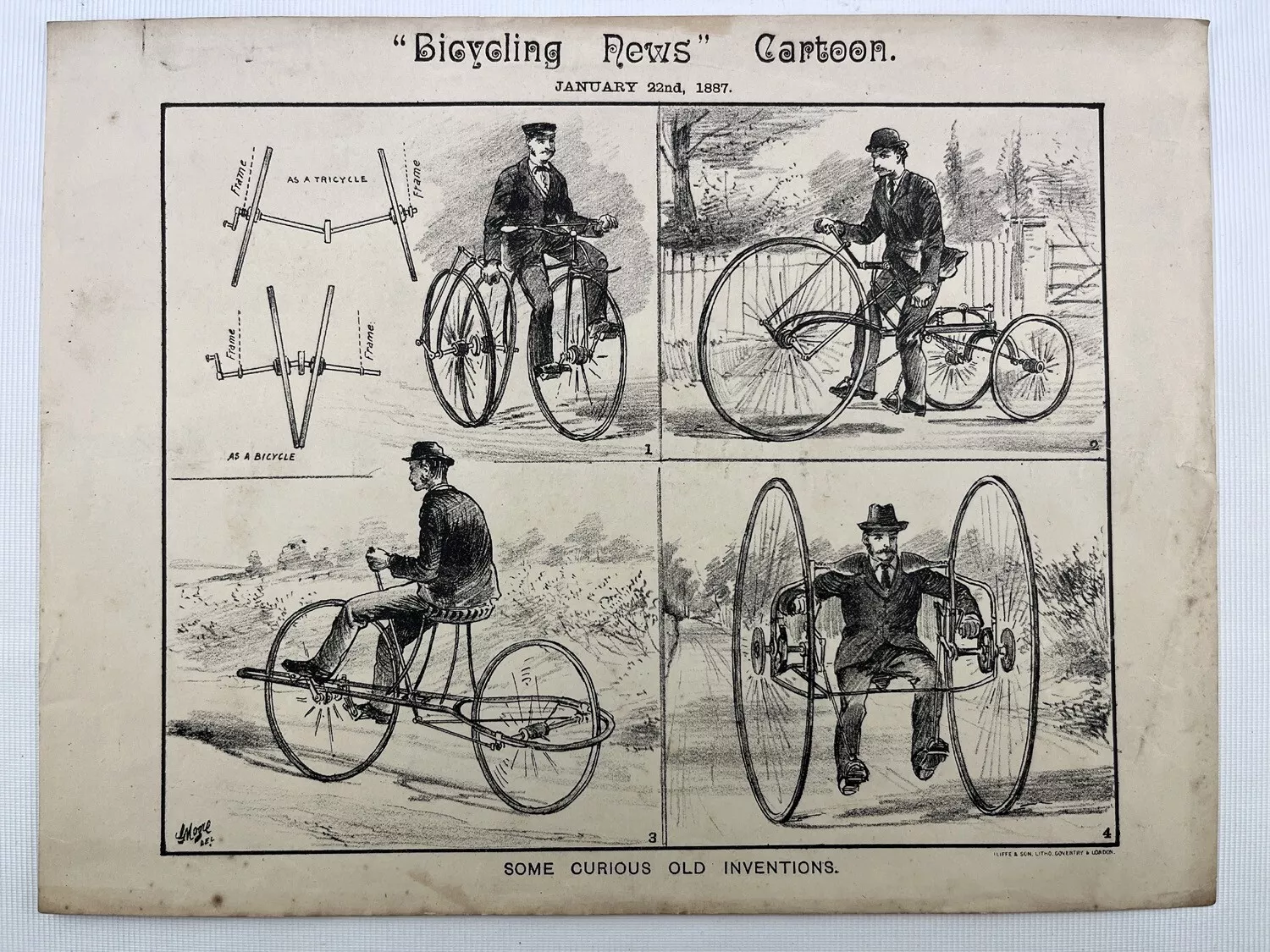
The evolutionary history of bicycles--from no gear to gear
Early Explorations
- In 1790, the Frenchman Comte de Sivrac invented the most primitive bicycle. It had only two wheels and no transmission device. When riding it, people needed to push the ground with both feet to make the vehicle roll forward. There was also no steering device, and when changing the direction, they had to get off and move the bike.
- In 1801, the Russian Ivan Petrovich Artamonov designed the world's first bicycle driven by pedals.
Formation of the Prototype
- In 1817, the German Karl Drais installed a rudder on the bicycle, enabling it to change the direction of travel. He added a handlebar for controlling the direction on the front wheel, which could change the direction of advancement. However, when riding, people still needed to push the ground with both feet to make the vehicle roll forward. He called it the "Laufmaschine" (running machine), and Karl Drais is generally recognized as the inventor of the bicycle.
- In 1839, the Scottish blacksmith Kirkpatrick Macmillan invented a pedal-driven bicycle. When riding, the two feet did not need to push the ground, which increased the driving speed. He also changed the wooden bicycle into an iron one.
Technological Development
- In 1861, the Michaux father and son in France installed rotatable pedal plates on the front wheel, and the saddle was mounted above the front wheel. They named it "bicycle" and exhibited it at the Paris Exposition in 1867. Later, due to safety issues, the saddle was changed to be fixed on the frame.
- In 1867, the Englishman Madison designed the first bicycle equipped with wire spokes.
- In 1869, Reynolds in the UK was the first to use spokes to tighten the rim, made the frame with steel pipes, and installed solid rubber belts on the rim, which greatly reduced the weight of the bicycle. In Stuttgart, Germany, a bicycle with rear-wheel steering and driving appeared. At the same time, components such as rolling bearings, freewheels, foot brakes, and springs were adopted on the bicycle.
Establishment of the Modern Style
- In 1874, the Englishman Henry Lawson installed a chain and sprocket on the bicycle, using the rotation of the rear wheel to drive the vehicle forward. It had the basic transmission form of a modern bicycle, but it was not very coordinated and stable.
- In 1886, the British mechanical engineer John Kemp Starley designed a new bicycle style from the perspectives of mechanics and kinematics. He installed a front fork and brakes, used roller bearings, made the front and rear wheels the same size to maintain balance, and made the diamond-shaped frame with steel pipes. He also used rubber wheels for the first time, which significantly improved the riding performance of the bicycle. He is also known as the "father of the bicycle" by later generations.
- In 1887, the Englishman Lawson completed the design of the chain-driven bicycle. In the same year, the German company Mannesmann first used seamless steel pipes in bicycle production.
- In 1888, the Irish veterinarian John Boyd Dunlop glued the rubber tubes used for watering in his garden into a circle, inflated them, and installed them on the bicycle, inventing the pneumatic tire. This fundamentally changed the riding performance of the bicycle, solved the vibration problem, and basically laid the foundation for the modern bicycle.
Popularization and Diverse Development
- From the early 20th century to before World War II, bicycles gradually became popular in regions such as Europe and the United States and became an important means of transportation for people. There were distinctions between men's bicycles and women's bicycles, and there were also some "bike enthusiasts" who decorated and improved the accessories.
- After World War II to the 1970s, the automotive industry developed rapidly, and bicycle production was affected. However, in the 1970s, due to the energy crisis, there was another bicycle boom in the world, and bicycle production developed rapidly again.
- From the 1980s to the 1990s, bicycles reached their peak of popularity in countries around the world, especially in Asian countries such as China, and became the main means of transportation. Well-known brands such as "Feige", "Forever", and "Phoenix" emerged in China. After the 1990s, with the further popularization of cars, the function of bicycles as a means of transportation declined somewhat. However, the functions of sports and leisure began to be valued, and various bicycles with different functions and styles, such as mountain bikes, gear-changing bikes, and racing bikes, emerged continuously.
- Since the 21st century, the functions of bicycles have become more diversified. In addition to sports and leisure, they are also combined with concepts such as environmental protection and urban transportation. The emergence of shared bicycles has even changed people's travel mode, and electric bicycles have also become an important means of transportation.
Cycle Gearing
The Development History of Track Cycling Events