
Types of Bike Brakes Explained: Rim, Disc and Coaster Brakes Dissected

Choosing the right brakes for your bike is a complex task that will influence your safety and determine your riding experience. Our guide explains everything you need to know about the different types of bike brakes out there.
Surprisingly, they are also often overlooked and not given enough thought. We get it, navigating through a sea of options is a daunting task, which is why we’ve created this guide — to simplify your choices.
We’ll tell you the basics of bike brakes, give you a rundown of different types (disc, rim, coaster, etc.), and compare some of the most popular options to help you make an informed decision.
Bike brakes are easily one of the most important parts of a bicycle. If they work well, they will improve your confidence, increase your safety, and might even save your life.
Let’s start with the basics.
Bike Brake Basics Explained
Bike brakes provide stopping power and control, both of which are incredibly important. Bicycle brakes allow you to control your speed, corner properly, descend safely and stop on a dime in case of any obstacle or emergency.
Most bicycle brakes work in a similar way and consist of similar bicycle brake parts. In terms of working principles, the two main bicycle brake types are mechanical and hydraulic brakes.
With the countless different types of brakes for a bike, it seems like a headache to figure out which one would fit your needs the best.
Mechanical brakes use a steel cable that connects the lever to the brake caliper, activates the caliper, and applies brake pads to the braking surface. Hydraulic disc brakes have a sealed hose with hydraulic fluid that compresses once the lever is pulled and activates the brake caliper.
The amount of stopping power and braking precision you get from a particular model of bicycle brakes depends on a lot of things. The most important ones include the quality of the components, the weather, the weight of the bicycle and the rider, tire grip, road surface, terrain, and so on.
Types of Bike Brakes
Even though rim and disc brakes are the two most common types of bike brakes, there are a few other less common types that you should also take into consideration.
All of these brake systems differ in terms of the braking power they provide, the way they attach to the bike, their intended use, and price, among other things.
Let’s dig deeper into the details of each type and learn about a few common subtypes as well.
Rim Brakes
As the name suggests, rim brakes use the rim of the wheel as the braking surface. The caliper attaches to the frame or the fork and brake pads squeeze the rim when you press the brake levers.
Rim brakes are most often seen on road bikes, cheap mountain bikes, and some hybrid and city bikes. However, more and more road bikes come with bicycle disc brakes nowadays as well.
The two most common subtypes of rim brakes are caliper and cantilever brakes.
Caliper brakes
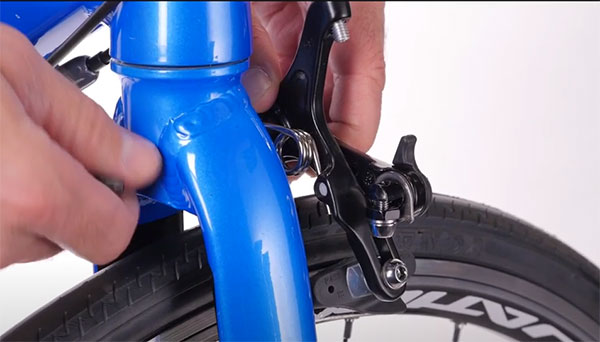
Caliper brakes are most commonly found on road bikes, especially on high-end lightweight models and inexpensive models.
They attach to the frame or the fork of the bike via a single bolt and are typically activated with a cable. There are a few hydraulic models out there, but these are very rare. In addition to the single-bolt variety, direct-mount caliper brakes that use two bolts are rising in popularity as well.
Caliper brakes can also be divided into single-pivot and dual-pivot, which refers to how the calipers pivot when activated. Dual-pivot models are more powerful and are the most common type on modern road bikes.
Cantilever and V-Brakes
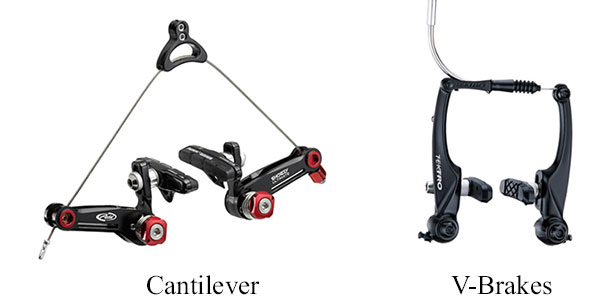
Cantilever brakes used to be common on cyclocross bikes, but they are slowly being replaced by bicycle disc brakes due to their superior performance in wet and muddy conditions.
The center-pull cantilever brakes have two brake arms attached on either side of the wheel, with a centrally lined cable pulled upwards when the brake lever is pressed.
They used to be common on cyclocross bikes because of having more clearance between the wheel and the mechanism compared to caliper brakes which translates to superior mud-shedding properties.
V-Brakes are another very common subtype of cantilever brakes found on affordable hybrids, city bikes, MTBs, and touring bikes. V-brakes also have two brake arms attached to either side of the rim, but the cable is mounted to the side, which means they are direct-pull, rather than center-pull. That means that one arm is pulled toward the rim, whereas the other arm is pushed toward the rim. On the center-pull variety, both arms are pulled toward the rim.
V-brakes are simple, cheap, and give you decent stopping power for everyday riding around the city. However, they are not a riders’ favorite on performance bikes due to subpar braking and modularity compared to other bicycle brake types.
exploring the secrets of bicycle cranks
16 Benefits Of A Fixed Gear Bike