
Crank selection for track cycling
2025-04-17

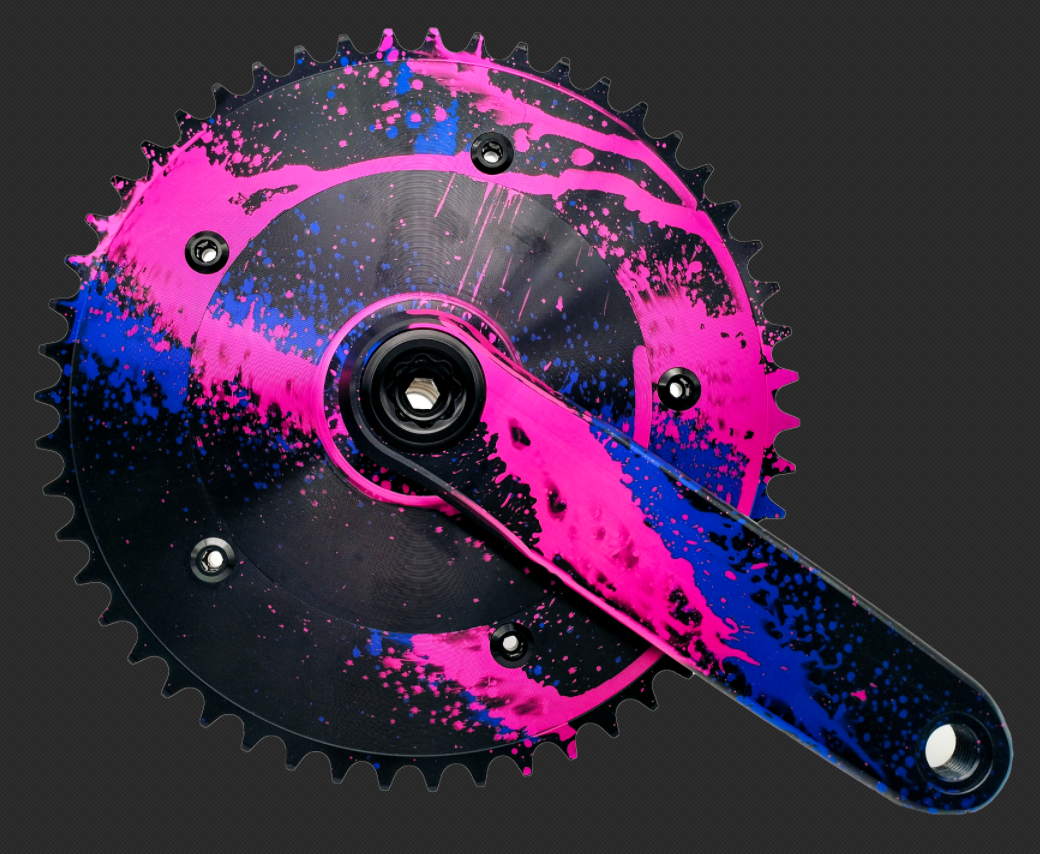
In the world of track cycling, every component is like a crucial gear in a precision instrument, playing a pivotal role in riding performance, and the crankset is one of the indispensable parts. Today, let's delve into the mysteries of choosing the crankset for track cycling together.
Crank Length: Discovering the Golden Size That Suits You
Once upon a time, it was commonly believed that 170cm was the most suitable crank length for the average male. However, with the continuous development of sports science, this traditional concept is gradually being rewritten. An increasing number of Fitters and coaches, through data and actual rider tests, strongly advocate the advantages of shorter cranks.
Under the action of the lever principle, in the past, people thought that the power output of a shorter crank was lower, and it was difficult to achieve normal power output in intense offensive and defensive battles in road races, thus missing out on good results. But after years of experiments by many experts and athletes, this theory has been refuted. Phil Cavell, the co-founder of CycleFit, pointed out: "On the same track, compared with a 170mm crank, a 165mm crank has a CdA (drag coefficient) that is a full 3.5% lower. This means that the rider requires less power when riding and can perform better in long-term power output."
Precisely because of this, shorter cranks are highly favored by track race riders who are extremely sensitive to power. For example, Tadej Pogačar, who is 176cm tall, first used a 172.5mm crank, reduced it to 170mm last year, and this year he decisively chose a 165mm crank. This change allows him to maintain a higher cadence, effectively reducing the pressure on his knees and legs. Even in high-intensity races lasting up to 5 hours, he can still stay in good condition at the crucial final moment.
The advantages of shorter cranks are more than that. It can increase the cadence, making the riding rhythm smoother; it can increase the clearance between the pedal and the ground when cornering, improving the safety of handling; it can also relieve lower back, joint, or muscle pain. For riding in an aerodynamic position (such as during a time trial), it can reduce the situation where the knee hits the chest or the handlebar.
Of course, not everyone is suitable for shorter cranks. There are still many professional riders who insist on using longer cranks. For example, Jonas Vingegaard (175cm tall) has always chosen a 172.5cm crank. He said that on the one hand, it is out of past habits, and he really couldn't get used to shorter cranks after trying them. On the other hand, considering the relatively low top tube of his Cervelo S5, a longer crank can provide more complete power output.
So, how can we determine our suitable crank length? If you are curious about the impact of changing the crank length on your riding experience, you might as well try BikeFitting and arrange a professional fitting service. Whether you are suffering from lower back pain, eager to increase your cadence, trying to open up your hip angle, or simply want to try something new, you can consider determining a more suitable crank through BikeFitting.
Crank Material: The Art of Balancing Performance and Budget
After determining the crank length, the choice of material is also of great importance. Different materials endow the crankset with different characteristics, and we need to weigh them according to our own needs and budget.
- Aluminum Alloy: Aluminum alloy cranks are widely used in the market due to their high strength and affordable cost. Top-grade aluminum cranks are carefully crafted along the metal grain during the casting process to further enhance their performance. For riders with a limited budget but still pursuing certain performance, aluminum alloy cranks are a good choice.
- Carbon Fiber: Carbon fiber cranks are highly favored by users who pursue extreme lightness and high rigidity due to their light weight and excellent rigidity. However, the carbon fiber material is relatively brittle and easily scratched, and protective sleeves usually need to be installed at both ends. If you are extremely sensitive to the weight of your bicycle and the riding environment is good, then carbon fiber cranks may be more in line with your needs.
- Titanium Alloy: Titanium alloy cranks combine the advantages of high strength, light weight, and durability. For example, the titanium crank for e-bikes launched by Cane Creek is made of 3D printed 6/4 titanium, containing about 90% titanium, plus 6% aluminum and 4% vanadium, as well as trace amounts of iron and oxygen. It not only has excellent corrosion resistance but also has an outstanding strength-to-weight ratio. Of course, titanium alloy cranks are relatively expensive in price and are suitable for riders who have extremely high requirements for performance and quality and have a sufficient budget.
Crank Specifications: Adapt to Your Bicycle
The specifications of the crankset are also factors to be considered when choosing. Classified according to the crankshaft axis, the common ones are as follows:
- The 24-millimeter axis in the Shimano camp: Represented by Shimano, this specification is widely used.
- The DUB specification developed by SRAM: The axis diameter reaches 28.99 millimeters. In comparison, it has higher hardness and strength.
- 30-axis core: It was more common in the era when the 8830 bottom bracket was popular, and the thickness of the axis core is 30 millimeters. However, due to the fact that its bearing material is prone to problems and produce abnormal noises, it is now rarely used.
- GXP specification: As SRAM's previous generation crankshaft axis specification, the thickness of the left and right axis cores is inconsistent. The chainring side is a 24-millimeter axis, and the non-drive side is a 22-millimeter axis. Currently, it has been basically phased out.
- Square-tapered crank: There is a square opening on the crank, and it needs to be used with a square-tapered bottom bracket. Special pullers are required for disassembly, and it is generally found in low-end and entry-level bicycles.
- Splined crank: The connection between the bottom bracket and the crank is a multi-tooth structure, similar to a square-tapered bottom bracket, and is now rarely seen.
In the choice of the crankset for track cycling, there is no absolute best answer, only the choice that suits you best. From the length to the material, and then to the specifications, every link requires us to comprehensively consider our own physical conditions, riding habits, budget, and riding goals and other factors. I hope that through today's introduction, it can help you clear the fog on the road of choosing the crankset and find that "perfect match" that suits you best, allowing you to be like a tiger with wings added in track cycling and fully enjoy the fun and passion of riding.
Types of Bicycle Riders
SNAIL Invite you to visit the 2025 China Shanghai International Bicycle Exhibition