Tips for using and maintaining your dead gear crank.
2025-03-18
Tips for using and maintaining your dead gear crank
Usage Tips
- Reasonable Force Application:When pedaling, try to maintain a smooth and continuous force, and avoid sudden and fierce pedaling. A uniform power output can make the crank transfer power to the sprocket more smoothly, reduce the impact on the crank and other components, and at the same time improve riding efficiency. For example, during the starting stage, increase the pedaling force slowly and steadily instead of suddenly exerting all the force at once.
- Find the Appropriate Pedaling Rhythm:Everyone's physical condition and riding habits are different, so it is necessary to find a pedaling rhythm that suits you. Generally speaking, a medium - speed pedaling rhythm is more efficient and energy - saving. You can continuously try different pedaling frequencies to feel at which rhythm the crank rotates most easily and the riding is the most comfortable. For instance, on a flat road, try a pedaling frequency of 80 - 100 times per minute.
- Avoid Overloading:Do not carry overly heavy items on a fixed - gear bike or engage in riding activities beyond its load - bearing capacity. Overloading will make the crank bear additional pressure, and over time, it may cause the crank to deform or be damaged. For example, do not carry too many heavy objects on a fixed - gear bike for long - distance heavy - load riding.
Maintenance Suggestions
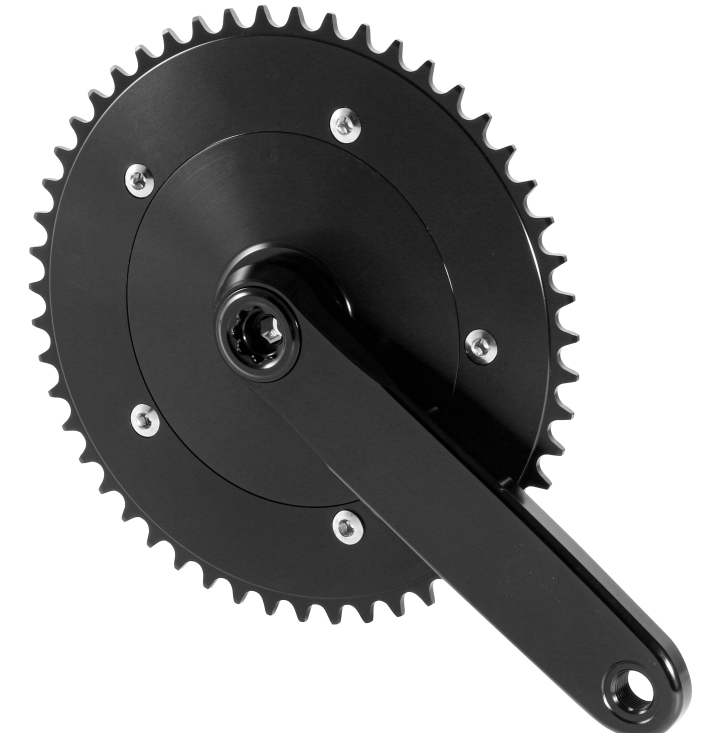
- Regular Cleaning:Regularly wipe the crank with a clean damp cloth to remove dust, dirt, and oil stains on the surface. Pay special attention to cleaning the dirt at the connection parts of the crank with the sprocket and the bottom bracket to prevent these impurities from entering the interior and affecting the smooth rotation. It is recommended to carry out a simple cleaning at least once a week and a deep cleaning once a month.
- Check Component Connections:Regularly check the connection parts of the crank with the pedals, sprocket, and bottom bracket to ensure that the screws and nuts are tightened. Loose connections may cause the crank to wobble during riding, which not only affects riding performance but also poses a safety hazard. Before each ride, you can simply check whether each connection part is firm.
- Lubrication Maintenance:Add an appropriate amount of lubricating oil to the rotating parts of the crank at regular intervals. For example, apply professional bicycle lubricating oil at the connection between the bottom bracket and the crank, which can effectively reduce friction, lower wear and tear, and extend the service life of the crank. Generally, perform lubrication maintenance every 200 - 300 kilometers of riding.
- Observe Wear Conditions:Regularly check the wear degree of the crank surface and the sprocket. If obvious wear marks are found on the crank, such as the rounded tips of the sprocket teeth, scratches or deformation on the crank arm, etc., it should be replaced in a timely manner. An overly worn crank may lead to unstable power transmission and even break during riding. It is recommended to conduct a comprehensive wear inspection every 1000 kilometers of riding.
Common Issues and Solutions of Fixed - Gear Bike Cranks
Fixed - Gear Bike Crank: The Core Power Driving Passion