
exploring the secrets of bicycle cranks
2025-07-10
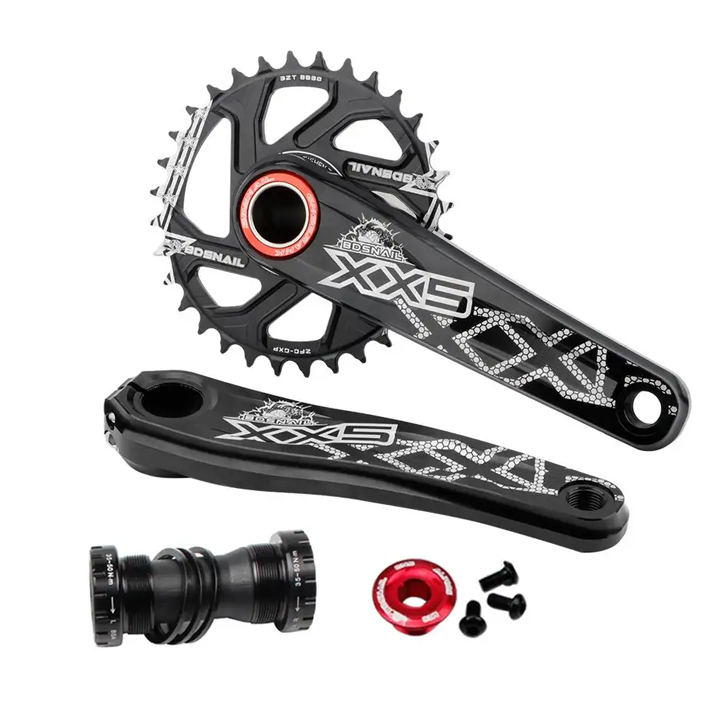
Unlocking a new realm of cycling: exploring the secrets of bicycle cranks
In the world of bicycles, every component is like a key gear in precision machinery, working together to bring a unique experience to riders. The crank, a seemingly ordinary but crucial component, is actually the core hub of bicycle power transmission. Its performance directly determines the efficiency, comfort and fun of riding. Today, let us explore the secrets of bicycle cranks together.
Source of power: the working principle of cranks
When we step on a bicycle and pedal, the power is transmitted to the crank through the crank. The crank is like an extension of the arm, converting the power of our legs into rotational power, driving the crank to run at high speed. The teeth on the crank are tightly engaged with the chain, transmitting power to the rear wheel accurately and accurately, pushing the bicycle forward. This process seems simple, but it contains exquisite mechanical principles. Every pedaling carries the rider's yearning for speed and freedom.
Various choices: Types and features of cranksets
One-piece cranksets
The one-piece crankset firmly connects the middle axle and the crank as one. This design greatly improves the overall rigidity and effectively reduces the loss during power transmission. During high-intensity riding, it can stably transmit power, allowing every effort of the rider to be transformed into forward momentum. It is very suitable for competitors and professional cycling enthusiasts who pursue extreme performance.
Hollow cranksets
The crank of the hollow crankset adopts a sealed hollow structure, which minimizes weight while ensuring strength. The lightweight design makes riding easier, especially on climbing sections, which can significantly reduce the burden on riders and make climbing no longer difficult. At the same time, the hollow structure can also improve aerodynamic performance, reduce wind resistance, and help riders speed on flat roads.
Hollow one-piece cranksets
As the mainstream choice in today's mid-to-high-end bicycle market, the hollow one-piece crankset combines the high rigidity of the one-piece crankset with the lightweight advantages of the hollow crankset. Hollow one-piece chainrings represented by Shimano SLX, XT, XTR series and SRAM Truvativ have won the favor of many cyclists with their exquisite manufacturing process and excellent performance. They not only have excellent rigidity and lightweight design, but also have excellent performance in durability, smoothness of gear shifting, etc., bringing cyclists a full range of high-quality experience.
Careful selection: How to choose the right crank chainrings
Clear needs, match performance
When choosing crank chainrings, first determine according to your riding style and needs. If you are an XC (cross-country bike) rider who pays attention to lightness and controllability, and the riding conditions are relatively good, then lightweight chainrings will be your best choice. But be aware that this type of chainring is usually fragile, so be careful when using it. On the contrary, if you often challenge complex terrain and need the chainring to have strong pressure resistance, it is more appropriate to choose a heavier and stronger chainring, such as products from brands such as RaceFace Atlas, Diabolus and DMR, which can withstand large drops and high-intensity impacts and are not easy to deform or break.
When choosing crank chainrings, first determine according to your riding style and needs. If you are an XC (cross-country bike) rider who pays attention to lightness and controllability, and the riding conditions are relatively good, then lightweight chainrings will be your best choice. But be aware that this type of chainring is usually fragile, so be careful when using it. On the contrary, if you often challenge complex terrain and need the chainring to have strong pressure resistance, it is more appropriate to choose a heavier and stronger chainring, such as products from brands such as RaceFace Atlas, Diabolus and DMR, which can withstand large drops and high-intensity impacts and are not easy to deform or break.
Consider the material and weigh the pros and cons
The material of the crank chainring has an important impact on its performance and weight. Common materials are aluminum alloy, carbon fiber and steel. Aluminum alloy crank chainrings are cost-effective, moderately strong and light, and are the first choice for most cyclists. Carbon fiber crank chainrings are highly regarded for their excellent rigidity and extreme lightness, which can significantly improve pedaling efficiency, but the price is relatively high and they are easily damaged when hit. Steel crank chainrings are the most durable, but they are heavy and are generally suitable for extreme riding environments with greater equipment wear and tear.
Pay attention to details and accurately fit
In addition to materials and performance, crank length and chainring specifications are also important factors that cannot be ignored. Common crank lengths range from 165mm to 177.5mm, with 2.5mm as a specification. Choosing the right crank length can ensure a comfortable and efficient riding posture and reduce damage to the knees. Generally speaking, riders with shorter legs can choose shorter cranks to increase pedaling frequency; while riders with longer legs and greater strength can choose longer cranks to exert greater power advantages.
In addition to materials and performance, crank length and chainring specifications are also important factors that cannot be ignored. Common crank lengths range from 165mm to 177.5mm, with 2.5mm as a specification. Choosing the right crank length can ensure a comfortable and efficient riding posture and reduce damage to the knees. Generally speaking, riders with shorter legs can choose shorter cranks to increase pedaling frequency; while riders with longer legs and greater strength can choose longer cranks to exert greater power advantages.
For chainrings, mountain bikes usually use 3 chainrings, with common tooth combinations of 44, 32 and 22 teeth. This configuration can provide a wide range of gear ratios to adapt to various road conditions. In some special scenarios, such as extreme off-road or urban riding, the combination of a small chainring and a guard, or a single chainring and a chain guide may be more practical. In addition, riders who ride longer mileage or often ride in bad weather conditions should choose a chainring with a more durable chainring to extend its service life.
Quality Choice: SNAIL Chainset
Snail chainset is the representative of high-end competition-level products. This series belongs to FSA's high-end K-Force product series, which is designed for high-performance and competition bicycles. The use of advanced carbon fiber materials and exquisite manufacturing technology has achieved an ideal balance of weight, rigidity and durability. The weight of the entire chainset of the new 53-39T chainring is only 544 grams. The hollow carbon fiber crank arm is made of 3k carbon fiber and is available in five lengths of 160, 165, 170, 172.5 and 175mm to meet the needs of different riders. The crank is treated with anti-wear/anti-scratch paint to maintain its perfect texture for a long time. The integrated design of the chainring greatly enhances its own rigidity and strength. At the same time, in order to facilitate the use with power chainring claws, the cross-legged crank adopts a detachable design, taking into account performance and versatility. The bright black KF - L STE logo on the lower part of the crank forms a sharp contrast with the matte appearance, highlighting the high-end quality. The chainring group supports 1X and 2X speeds, and can be adapted to 11-speed and 12-speed, providing a variety of choices for competitors with different riding styles and needs.
Snail chainset is the representative of high-end competition-level products. This series belongs to FSA's high-end K-Force product series, which is designed for high-performance and competition bicycles. The use of advanced carbon fiber materials and exquisite manufacturing technology has achieved an ideal balance of weight, rigidity and durability. The weight of the entire chainset of the new 53-39T chainring is only 544 grams. The hollow carbon fiber crank arm is made of 3k carbon fiber and is available in five lengths of 160, 165, 170, 172.5 and 175mm to meet the needs of different riders. The crank is treated with anti-wear/anti-scratch paint to maintain its perfect texture for a long time. The integrated design of the chainring greatly enhances its own rigidity and strength. At the same time, in order to facilitate the use with power chainring claws, the cross-legged crank adopts a detachable design, taking into account performance and versatility. The bright black KF - L STE logo on the lower part of the crank forms a sharp contrast with the matte appearance, highlighting the high-end quality. The chainring group supports 1X and 2X speeds, and can be adapted to 11-speed and 12-speed, providing a variety of choices for competitors with different riding styles and needs.
As a key factor affecting the riding experience, bicycle cranks carry our love and pursuit of riding. Choosing a high-quality crank that suits you is like injecting a strong heart into the bicycle, allowing us to release our passion on the road of riding, chase the speed of the wind, and enjoy every wonderful journey. Whether you are a competitor who pursues speed and passion, or a leisure enthusiast who loves free riding, you can find your perfect partner in the rich and diverse world of cranks and start a unique riding journey.
Bicycle discs: the key guardian of riding safety and performance
Types of Bike Brakes Explained: Rim, Disc and Coaster Brakes Dissected