
Benefits of Carbon Fiber Cranks
2025-04-01

Carbon fiber cranks are widely used in the field of bicycles. The following is a detailed introduction to their advantages:
- Lightweight
- The main component of carbon fiber is carbon element, and its density is usually between 1.7 and 2.0 grams per cubic centimeter. In contrast, the density of common metal materials such as aluminum alloy is about 2.7 grams per cubic centimeter, and the density of steel is even higher, about 7.8 to 8.0 grams per cubic centimeter. This enables a carbon fiber crank to be approximately 30% to 50% lighter in weight compared to a metal crank of the same size.
- For example, the weight of an ordinary aluminum alloy crank may be around 300 to 400 grams, while a carbon fiber crank can have its weight controlled within 200 to 300 grams. During cycling, especially on uphill sections, the lighter crank can significantly reduce the burden on the legs, making it more labor-saving for the rider. When accelerating on flat roads, it is also easier to increase the speed, which helps to improve the cycling efficiency.
- High Strength
- Carbon fiber has extremely high strength and rigidity. Its tensile strength generally ranges from 3000 to 5000 MPa, and some high-end carbon fiber materials can even reach over 7000 MPa, while the tensile strength of common aluminum alloy is usually between 200 and 400 MPa. This means that the carbon fiber crank can withstand greater external forces and torques without deformation.
- When the rider pedals forcefully, the carbon fiber crank can efficiently transfer the force to the chain and wheels with almost no energy loss. Even during high-intensity cycling, such as sprinting, sudden acceleration, or when dealing with complex road conditions, the carbon fiber crank can maintain stable performance and is not prone to problems such as breakage or deformation, providing reliable support for the rider.
- Good Shock Absorption Performance
- Carbon fiber materials have unique viscoelastic properties, which enable them to absorb and buffer the vibrations and impacts generated during cycling to a certain extent. Compared with metal cranks, carbon fiber cranks can reduce the transmission of vibrations to the rider's body by at least 20% to 30%.
- When cycling over bumpy roads, speed bumps, or uneven roads, the carbon fiber crank can effectively filter out part of the vibrations, significantly reducing the vibrations felt by the rider's hands, arms, and body. This not only improves the riding comfort but also reduces the fatigue of the body during long rides, allowing the rider to maintain a good riding state for a longer time.
- Corrosion Resistance
- Carbon fiber itself has strong chemical stability and will not easily undergo oxidation reactions with oxygen and moisture in the air like metals, so it won't rust. At the same time, it also has good resistance to common acids and alkalis.
- In daily cycling, whether it is in rainy weather, the rider's sweat dripping on the crank, or cycling in some harsh environmental conditions, the carbon fiber crank will not be corroded due to these factors, thus maintaining the integrity of its performance and appearance. In contrast, if metal cranks do not have good protective measures, they are likely to rust and corrode, affecting their service life and performance.
- Flexible Design
- Carbon fiber can achieve various mechanical properties and appearance effects through a variety of braiding methods, such as unidirectional braiding, bidirectional braiding, twill braiding, etc., as well as different layup designs. At the same time, the molding process of carbon fiber is relatively flexible, and it can be made into various complex shapes and structures.
- Bicycle manufacturers can design carbon fiber cranks with unique shapes according to the design requirements of different models and the characteristics of the target user group. For example, in order to pursue ultimate aerodynamic performance, streamlined carbon fiber cranks with special aerodynamic shapes can be designed; to meet the personalized needs of some riders, unique patterns or colors can be designed on the surface of the crank. In addition, according to the height, weight, and riding habits of different riders, the length, angle, etc. of the carbon fiber crank can be customized to provide a more comfortable and efficient riding experience.
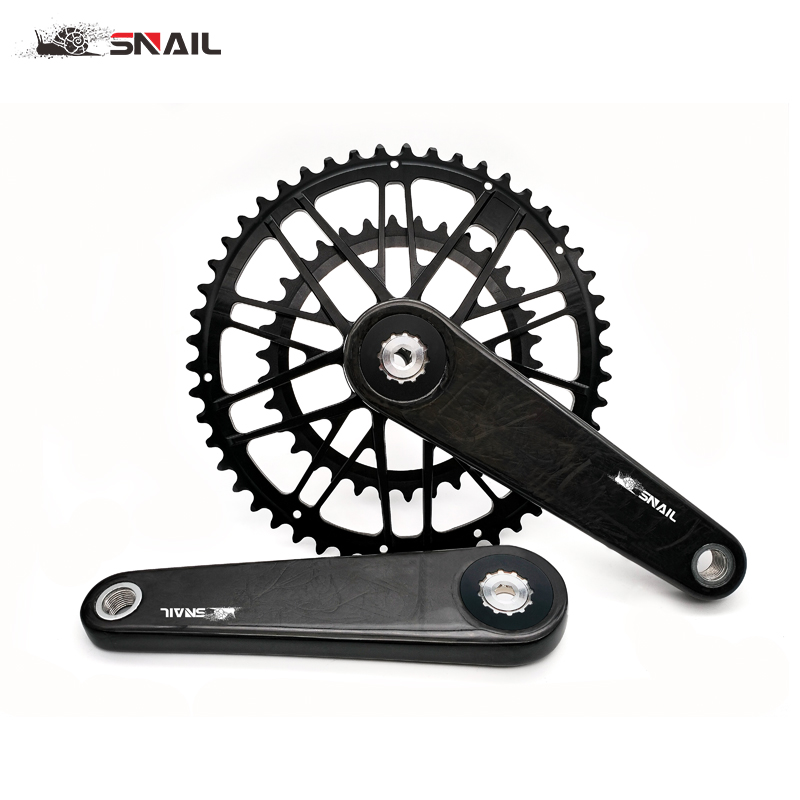
Unleash Your Cycling Potential with Carbon Fiber Bicycle Components
Carbon Cranks, Disc Brake Rotors, and Narrow Chainrings