
Bicycle Crank: The Core of Cycling Power
2025-04-29

Bicycle Crank: The Core of Cycling Power
In the complex structure of a bicycle, the crank, although seemingly unassuming, is of crucial importance. It is the key hub that enables cyclists to convert their own power into forward motion. The quality of its performance directly affects the cycling efficiency, comfort, and overall experience.
The main function of the crank is to convert the circular motion of pedaling into the linear motion of the chain, thereby driving the rear wheel to rotate. This process, looks simple, actually involves many complex mechanical principles. The length, material, and design of the crank all play decisive roles in it.
First, let's talk about the crank length. Cyclists with different heights and leg lengths are suitable for different crank lengths. Common crank lengths range from 165 millimeters to 175 millimeters, with an increment of 2.5 millimeters. Generally, the common crank length for road bikes is 172.5 millimeters, and for mountain bikes, it is mostly 170 millimeters or 175 millimeters. Longer cranks can provide greater leverage, which is suitable for taller cyclists and has obvious advantages on flat roads or when explosive power is required. Shorter cranks, on the other hand, are more conducive to maintaining a high pedaling cadence and are favored by triathletes, especially in long - distance rides, as they can effectively reduce fatigue. Choosing the right crank length can make the cyclist's pedaling motion more natural and smooth, with more efficient power output, reducing unnecessary energy loss.
In terms of materials, there is a wide variety of cranks. Traditional aluminum alloy cranks, with their good strength and relatively light weight, have become the standard configuration for many bicycles. Aluminum alloy materials not only have a relatively low cost but also have excellent durability, which can meet the needs of daily cycling and most cycling enthusiasts. High - end bicycles often use carbon fiber cranks. The biggest advantage of carbon fiber cranks lies in their extreme light weight, while still ensuring excellent rigidity. For example, some top - of - the - line carbon fiber cranks can weigh as little as over 300 grams. While reducing the overall weight of the bicycle, cyclists can feel a more direct and efficient power transfer during acceleration, climbing, and sprinting. High rigidity means that during the pedaling process, the deformation of the crank is minimal, and the cyclist's power can be transmitted to the chain almost without loss, improving cycling efficiency.
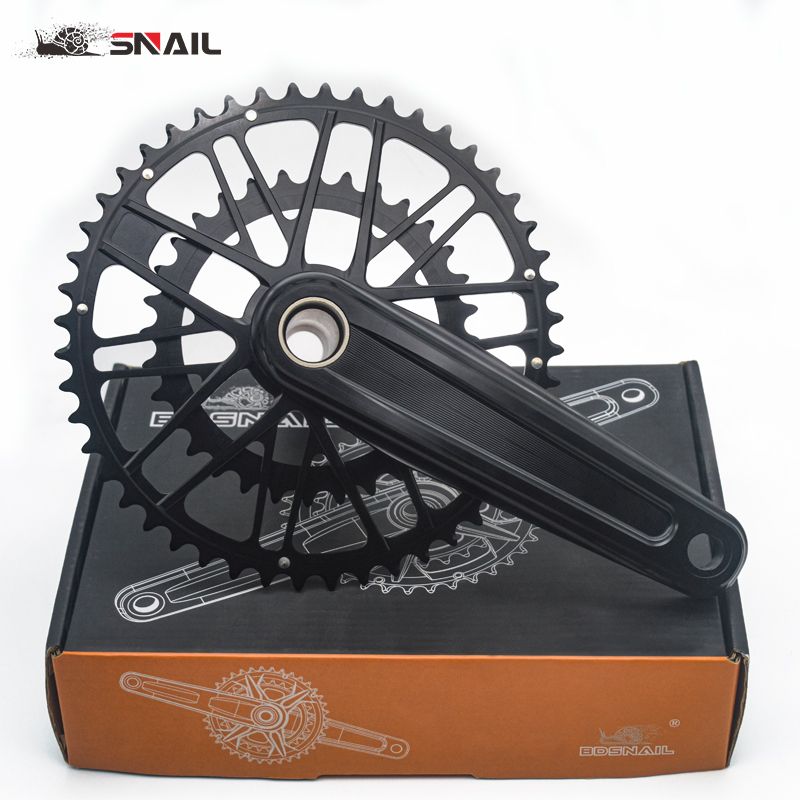
Looking at the design of the crank, BCD (Bolt Circle Diameter) is a key parameter. On traditional crank sets, the chainring is fixed to the right crank arm through bolts, and the distance that the center line of the bolts passes through the bolt circle is the BCD. Different crank sets may have different BCD values, which directly affects the compatibility of the chainring. For example, many road crank sets from Shimano have four unevenly distributed tabs, while SRAM's 11 - speed road bike crank sets have five evenly distributed tabs. When replacing the chainring, it is necessary to ensure that its BCD value is consistent with that of the crank set, otherwise, it cannot be installed. In addition, direct - mount crank sets have become increasingly popular in recent years. This design directly fixes the outer chainring to the main shaft of the crank set, reducing the number of bolts in the crank arm, reducing weight, and at the same time improving the overall rigidity and simplicity. It is widely used in single - chainring cranks for mountain bikes and gravel bikes.
With the continuous development of bicycle technology, the innovation of cranks has never stopped. Nowadays, some cranks are also integrated with power meters, which can real - time monitor the power output of cyclists. This function is like a "secret weapon" for professional athletes and cycling enthusiasts who pursue precise training. By analyzing the power data, cyclists can more scientifically formulate training plans, precisely control the cycling intensity, and improve training effects. Moreover, the compatibility of cranks is also constantly improving. Whether it is to match bottom brackets of different brands or to adapt to various types of chainrings, it has become more convenient, allowing cyclists to easily create a personalized bicycle transmission system according to their own needs and preferences.
When choosing a bicycle crank, cyclists should comprehensively consider their own cycling needs, physical conditions, and budget. Should they pursue the ultra - light and high - performance carbon fiber cranks or focus on the cost - effective aluminum alloy cranks? Should they choose shorter cranks suitable for long - distance rides or longer cranks that can better exert explosive power? Different choices will bring completely different cycling experiences.
The bicycle crank, this seemingly unremarkable component, is actually the core soul of cycling. It silently bears every pedal stroke of the cyclist, converts power into forward motion, and accompanies cyclists through mountains, rivers, lakes, and seas, enjoying the scenery along the way. Choosing a suitable crank is to inject a powerful power source into the cycling journey, making every ride more enjoyable and carefree.
Anatomy of a Bicycle: A Beginner's Guide to Every Part
Bicycle face