
Bicycles & How They Work
2025-04-25
Bicycles & How They Work
Today's bicycles are almost identical to bicycles
developed in the late 19th century when light bulbs and telephones were invented.
Since the beginning of the 20th century, structure of a bicycle has remained largely unchanged:
• A‘diamond’frame, comprised of tubes forming two triangle shapes;
• Two wheels with rubber-covered tires filled with pressurized air;
• A drivetrain with a chain fitted around two sprockets, moved forward by pedal rotation.
Bicycle Types
Balance bikes are bicycles without pedals, used to introduce children to cycling. Variations of balance bikes include kick bikes, which use a small platform instead of a saddle, like a scooter.

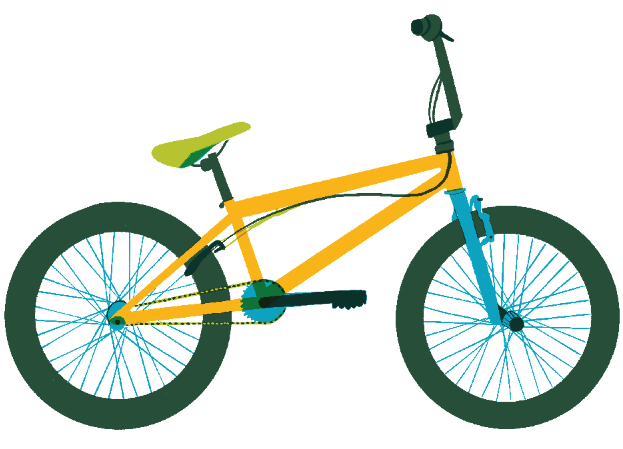
BMX bikes have shorter frames than many bikes, and are typically used off-road for recreation, in dirt course competitive races, and for stunt-riding.

Cargo bikes can be used to haul groceries or other small loads, carry children, and perform tasks sometimes handled by motor vehicles. Variations include the bakfiets, longtail, and box trike models; some cargo bikes come with electric motors to help with heavier loads or longer distances.

Commuter bikes have a more upright riding position, multiple gears, and racks for carrying bags or packs. They are designed for frequent rides in a variety of road conditions.

Electric bikes (e-bikes) are like regular bikes, with the addition of battery-powered drivetrains that typically make them more expensive than many other types. E-bikes help riders go uphill, travel longer distances faster, and tote heavier loads with less effort than bikes powered only by human effort.

Fixies are usually lightweight road bikes with a single, fixed gear and minimal accessories so they can be used for quick, local trips, often by bicycle couriers. Fixed gear bikes are also used in track racing.

Folding bikes have short, light frames, and smaller wheels than most bikes; hinges allow them to be folded up and carried like luggage. Folding bikes are popular for commuting and touring.

Mountain bikes have short frames, shock absorbers (suspension), and thick, knobby tires, which provide traction and maneuverability for rougher terrain such as on mountain trails and courses. Hardtail mountain bikes have front suspension only, while full suspension bikes have front and rear suspension.

Road bikes generally have lightweight frames and low, curved handlebars (‘drop bars’). Thin, smooth tires reduce friction for a faster and more efficient ride. Touring bikes are heavy duty road bikes built to carry loads comfortably. Cyclocross and gravel bikes are road bikes intended for use on rougher roads and courses.

City bikes and cruisers provide a comfortable and upright riding position so they’re easy to mount and ride recreationally. Some city bikes have more open (or ‘step-through’) frames, wide tires, and baskets or racks, and are commonly used in public bike share systems.

Hybrid bikes combine the construction and features of different bike types, providing versatility to serve a variety of cycling styles or needs.

Bicycle face
Launched a New Product - One - Piece Crank