
Tour de France: A Legendary Feast in the Cycling World
2025-04-14

Tour de France: A Legendary Feast in the Cycling World
In the vast field of sports, the Tour de France is undoubtedly a dazzling star, emitting unique and charming charm. This event is not only the pinnacle competition of cycling, but also a vivid portrayal of courage, perseverance and team spirit, attracting the attention of countless cycling fans around the world.
A Century of Legend, Tracing the Glory
The history of the Tour de France can be traced back to 1903. At that time, Henri Desgrange, the editor-in-chief of L'Auto, and his collaborator, Géo Lefèvre, came up with the idea of holding a large-scale cycling race during a dinner. Lefèvre proposed organizing a multi-stage cycling tour around France, and this creative idea was quickly recognized by Desgrange. On January 19th of the same year, L'Auto announced the birth of the Tour de France on its front page. On July 1st, the first Tour de France grandly opened, and 78 cyclists embarked on the journey with their dreams. The first edition consisted of six stages, with a total length of 700 kilometers. The cyclists set off from Paris, passing through Lyon, Marseille, Bordeaux and Nantes, and finally returned to Paris. The French cyclist Maurice Garin became the champion of the first Tour de France with his outstanding performance. Since then, the Tour de France has gradually grown and developed. In 1906, the fourth edition of the event stepped out of France for the first time, entering countries such as Germany, Spain and Italy, and the number of stages increased to 15. In 1910, the Pyrenees Mountains were incorporated into the route, and Octave Lapize successfully climbed over 11 peaks, becoming the first King of the Mountains in history. After going through the baptisms of the two World Wars, the Tour de France still continued tenaciously, witnessing the glory and dreams of countless cyclists.
A Grueling Schedule, Challenging the Limits
The Tour de France is a multi-day race. It usually kicks off in early July every year and lasts for 23 days, with a total of 21 stages and a total distance of about 3,200 kilometers. In recent years, the total mileage has been about 3,540 kilometers. The stage forms are rich and diverse. According to the competition format, it is divided into individual time trials and mass start races. According to the race roads, it is divided into flat stages and mountain stages, among which the altitude of the mountain stages can reach up to 2,200 meters. The starting route changes every year. About 22 professional teams participate, and each team sends 9 cyclists. During the race, the cyclists face enormous physical challenges. They not only have to maintain high-speed cycling during the long race, but also cope with complex and changeable terrains. In the flat stages, the cyclists need to rely on excellent explosive power and team cooperation to strive for the fastest speed; while in the mountain stages, the steep slopes and thin air test the cyclists' endurance and willpower. They sweat profusely under the scorching sun and struggle forward in the wind and rain, and every pedal stroke is full of the desire for victory.
Colorful Jersey, Symbols of Glory
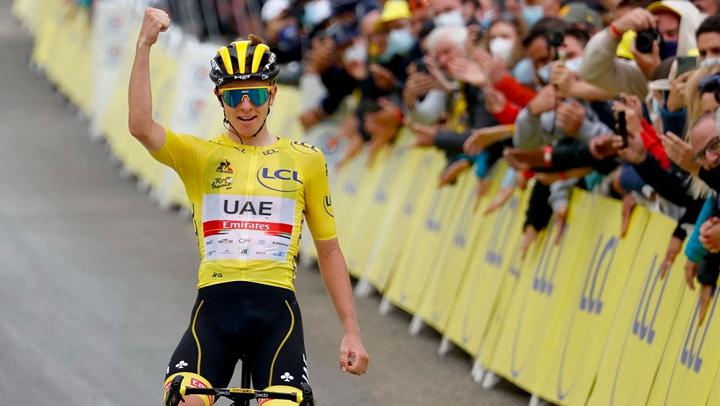
One of the highlights of the Tour de France is the different colored jerseys, which represent different honors. The cyclist leading the overall standings wears the yellow jersey, which is a symbol of victory and glory and the coveted honor of all cyclists. The leader in the overall points standings wears the green jersey, demonstrating his outstanding strength in the sprint sections. The cyclist with the best climbing performance wears the polka-dot jersey and is hailed as the "King of the Mountains", which is a high recognition of the cyclist's climbing ability. The best cyclist under 25 years old wears the white jersey, representing the infinite possibilities of youth and the future. The stage winner will also put on the pink jersey and enjoy their moment in the spotlight. These colorful jerseys have become a series of beautiful scenery on the track, inspiring the cyclists to constantly surpass themselves.
Legendary Figures, Shining in the Cycling World
In the long history of the Tour de France, many legendary figures have emerged. The French champion Jacques Anquetil was truly a king. After winning his first title in 1957, he dominated the race for four consecutive years from 1961 to 1964, starting the first dominant dynasty in the history of the Tour de France. The Belgian champion Eddy Merckx, nicknamed "The Cannibal", had astonishing dominance. He won the championship for four consecutive years from 1969 to 1972 and won again in 1976. The French champion Bernard Hinault dominated the Tour de France in the late 1970s and early 1980s, winning the title five times. The Spanish champion Miguel Indurain achieved five consecutive championships in the early 1990s, showing great strength. These legendary figures have written brilliant chapters in the history of the Tour de France with their outstanding performances and have become eternal idols in the hearts of cycling fans.
Modern Changes, Continuous Development
With the development of the times, the Tour de France is also constantly changing and innovating. The event organizers are constantly optimizing the race schedule to increase the entertainment and challenge of the competition. At the same time, stricter measures have been taken against doping issues to maintain the fairness and justice of the event. In recent years, the Tour de France has become increasingly internationalized, attracting top cyclists from all over the world. Chinese cyclist Ji Cheng finished 164th in the 101st Tour de France in 2014, becoming the first Chinese cyclist to complete the Tour de France, which also indicates the increasingly close connection between the Tour de France and China. The 2024 Tour de France even started in Italy for the first time, with the race route passing through four countries: Italy, France, San Marino and Monaco, showing the diversity and inclusiveness of the event.
The Tour de France is not only a sporting event, but also a symbol of a spirit. It inspires people to move forward bravely, challenge themselves and pursue excellence. In the future, it is believed that the Tour de France will continue to write its own legend and bring more excitement and touches to cycling fans around the world.
Chasing the Wind on the Prairie
What Is Bicycle