
Crank Drive: A Crucial Transformation in the History of Bicycles
2025-04-09

Crank Drive: A Crucial Transformation in the History of Bicycles
Bicycles have evolved from simple means of transportation in the early days to diverse and efficient modes of travel through numerous innovations. Among these, the addition of the crank as a driving device is undoubtedly one of the most pivotal turning points, exerting a comprehensive and profound influence on the development of bicycles.
I. Significantly Enhancing Driving Efficiency
(A) Optimizing the Power Transmission Path
In the era when bicycles had no driving devices, people could only propel the vehicle forward by repeatedly pushing the ground with their feet. This primitive driving method led to extremely scattered and inefficient power transmission. Each time the ground was pushed, the force was difficult to act precisely and continuously in the direction of the bicycle's movement, and a large amount of energy was lost due to dispersion and friction during the transmission process.
The emergence of the crank drive system completely changed this situation. The crank is closely connected to the wheel through a carefully designed connecting rod. When the rider pedals the crank, the generated force can be directly and efficiently transmitted to the wheel along the established mechanical structure, converting into the rotation of the wheel and driving the bicycle forward. This is like opening up an exclusive "expressway" for energy, reducing unnecessary energy loss, and enabling every bit of pedaling force to be effectively transformed into the power to propel the bicycle forward. According to relevant research, compared with bicycles without a drive system, bicycles equipped with a crank drive system have increased the power transmission efficiency by approximately 30% - 40%. This means that riders can obtain greater forward power with less effort.
(B) Achieving Circular Motion Drive
The unique design of the crank enables the rider to drive the bicycle through circular motion, which is essentially different from the previous linear reciprocating motion (such as pushing the ground with the feet). Circular motion has significant advantages of continuity and smoothness. During the process of pedaling the crank, the rider's force can be applied continuously and evenly, enabling the wheel to maintain a stable rotational speed and avoiding large fluctuations in speed caused by linear reciprocating motion.
Take the riding scenario on a flat road as an example. A bicycle driven by a crank can travel at a relatively stable speed. The rider only needs to pedal evenly according to their own rhythm, and the bicycle can maintain a stable forward speed. There is no need to experience the process of speed decay from fast to slow after each pedal like a bicycle without a drive system and then accelerate again. This stable speed output not only makes the ride smoother but also allows the rider to reach and maintain a higher driving speed more easily. Generally, under the same physical exertion, the speed of a bicycle equipped with a crank drive can be 2 - 3 times higher than that of a bicycle without a drive, greatly improving travel efficiency and enabling riders to reach their destinations in a shorter time.
II. Significantly Improving the Riding Experience
(A) Creating a Comfortable Riding Posture
The introduction of the crank drive system has brought about a revolutionary change in the rider's posture. In the era of bicycles without a drive system, riders often had to push the ground with their feet frequently, and their body postures were forced to be adjusted continuously, making it difficult to find a comfortable and stable state. After the addition of the crank, the rider can sit steadily on the saddle, place their feet naturally on the pedals of the crank, and keep the body upright or slightly leaning forward.
This new riding posture has many advantages. Firstly, it enables the rider's body weight to be more evenly distributed on various parts of the bicycle. The saddle bears most of the body weight, and the feet provide auxiliary support by pedaling the crank, reducing the pressure on various parts of the body, especially the waist and legs. For those who ride for a long time, this posture can effectively relieve fatigue and reduce the risk of physical pain caused by improper posture. Secondly, the stable riding posture helps the rider better control the bicycle. With the center of gravity relatively fixed, the hands can focus more on grasping the handlebars and performing operations such as turning and braking, greatly improving the safety and maneuverability of riding.
(B) Reducing Riding Fatigue
In addition to changing the riding posture, the crank drive system also fundamentally reduces the fatigue during the riding process. When riding a bicycle without a drive system, the rider needs to exert force to push the ground frequently. Each push requires the mobilization of a large number of leg muscles, and the movement is relatively rigid and inconsistent, making the leg muscles extremely prone to fatigue.
The crank drive system allows the rider to output force in a more regular and smooth manner. Through the pedaling method of circular motion, the rider can utilize the natural contraction and relaxation rhythm of the leg muscles to continuously and effortlessly provide power for the bicycle. In addition, since the crank drive system can achieve a stable speed output, the rider does not need to accelerate and decelerate frequently as before, reducing unnecessary energy consumption and muscle tension. Research data shows that when riding the same distance on a bicycle driven by a crank, the rider's fatigue is reduced by approximately 40% - 50% compared with that on a bicycle without a drive system, making riding more relaxed and enjoyable. Even long-distance riding is no longer a daunting challenge.
III. Strongly Promoting the Popularization of Bicycles
(A) Enhancing the Practicality of Bicycles
The application of the crank drive system has greatly enhanced the practicality of bicycles. Before this, due to the limitations of the driving method, bicycles were slow in speed and short in driving distance, and their application scenarios in actual travel were relatively limited. They were more regarded as a novel toy or a short-distance means of transportation.
With the crank drive, the speed and endurance of bicycles have been significantly improved, meeting people's travel needs in more scenarios. Whether it is daily commuting, shopping, or medium and short-distance travel, bicycles have become a reliable and convenient choice. For example, in the city, office workers can ride bicycles equipped with a crank drive system to quickly shuttle through the streets, avoiding congested traffic and arriving at their workplaces on time; people can also ride bicycles to surrounding parks and scenic spots on weekends to enjoy the fun of riding. The improvement of the practicality of bicycles has enabled them to truly integrate into people's daily lives and become an indispensable means of transportation.
(B) Lowering the Threshold for Riding
The emergence of the crank drive system has also lowered the threshold for riding bicycles, allowing more people to easily master riding. In the era of bicycles without a drive system, due to the more laborious riding method and the difficulty of maintaining balance, it required a high level of physical strength and skills from the rider, making many people discouraged from riding bicycles.
However, bicycles driven by a crank make riding easier to learn through optimized riding postures and driving methods. Even beginners without riding experience can master the basic riding skills within a short period. The relatively stable riding experience and lower physical requirements have attracted people of all ages and different physical conditions to join the ranks of riding. Whether it is teenagers, adults, or the elderly, they can all find their own fun on bicycles. This wide applicability has greatly expanded the audience of bicycles and laid a solid foundation for the global popularization of bicycles.
IV. Deeply Promoting the Development of Bicycle Technology
(A) Laying the Foundation for Technological Innovation
The addition of the crank is an important milestone in the history of bicycle development, laying a solid foundation for a series of subsequent technological innovations. It established the basic driving mode of modern bicycles, transforming bicycles from simple human-powered devices into complex and efficient mechanical systems.
Based on the crank drive system, engineers began to conduct in-depth research and improvement on other components of bicycles. For example, in order to better match the power output of the crank and the rotational speed of the wheel, the chain and sprocket came into being. The combination of the chain and sprocket not only realizes the long-distance transmission of power but also achieves the variable speed function of the bicycle through the matching of sprockets of different sizes, enabling the rider to adjust the riding resistance and speed according to different road conditions and riding needs. Another example is that in order to ensure the stable and efficient operation of the crank drive system, the frame structure of the bicycle has also been optimized, enabling it to better withstand various stresses during the riding process. It can be said that the emergence of the crank drive system opened the door to technological innovation in bicycles, creating conditions for the continuous improvement of bicycle performance and functions in the future.
(B) Triggering Technological Iteration and Upgrading
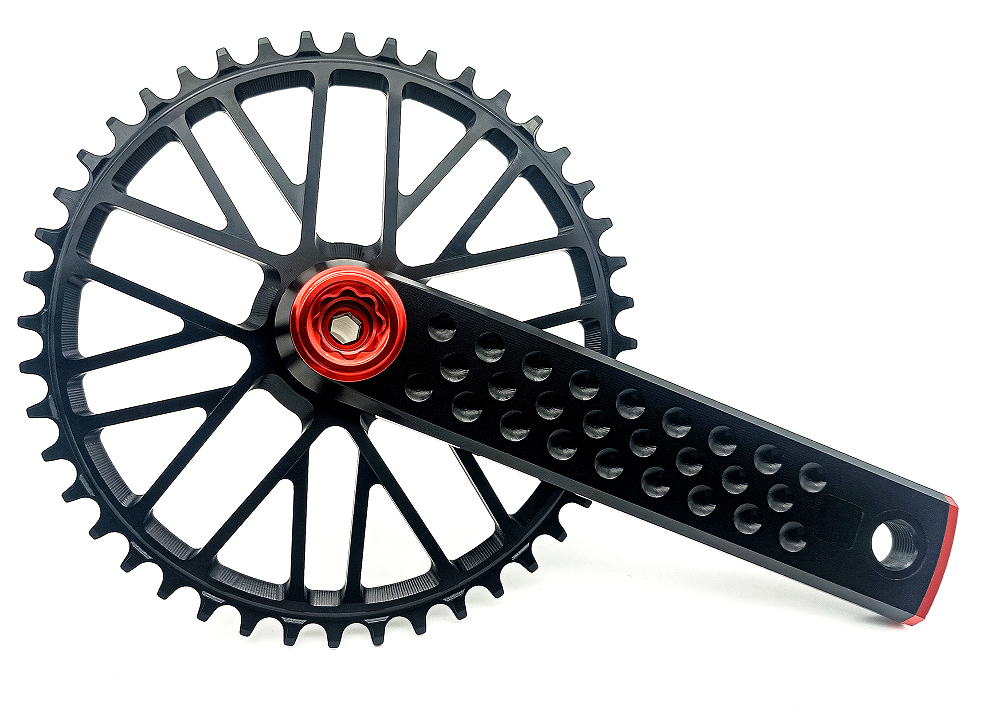
Since the birth of the crank drive system, it has continuously promoted the iterative upgrading of bicycle technology. With the continuous progress of materials science, manufacturing processes, and engineering technology, the design and manufacturing of the crank itself are also continuously improving. From the simple metal cranks in the early days to the advanced cranks made of high-strength and lightweight carbon fiber and other materials today, not only has the durability of the crank been improved, but also the overall weight of the bicycle has been further reduced, enhancing the riding performance.
At the same time, around the crank drive system, other components of the bicycle are also evolving continuously. The transmission system has gradually developed from the initial simple structure to the current multi-gear and precise variable speed system, which can adjust the riding resistance more finely; the braking system has also been upgraded from a simple braking device to efficient and reliable disc brakes, hydraulic brakes, etc., ensuring that riders can brake safely at various speeds and road conditions. In addition, modern bicycles have also integrated electronic technology, intelligent sensing technology, etc. For example, electric assist bicycles provide additional power support for riders through the assistance of the motor to the crank drive, further expanding the application fields and functions of bicycles. It can be said that the crank drive system is like the engine of bicycle technology development, continuously driving bicycle technology to move forward in the direction of higher performance and greater intelligence.
What is the development history of the crank part of a bicycle?
World's first bicycle ride took place 200 years ago