
Road bike crank: the core conductor of pedaling force
2025-03-21

Road bike crank: the core conductor of pedaling force
In the sophisticated and complex mechanical system of road bikes, the crank plays a very critical role and can be called the core conductor of pedaling force. It seems to be just a simple component connecting the pedals and the sprockets, but in fact it embodies countless design ingenuity and advanced technology, and is an important part of determining the quality of the riding experience.
Road bike cranks are usually made of strong and lightweight materials, such as aluminum alloy and carbon fiber. Aluminum alloy cranks are popular for their excellent strength and good cost performance. After careful forging and processing, they can withstand the huge force exerted by the rider when pedaling without adding too much burden to the bicycle. Carbon fiber cranks represent the ultimate pursuit of lightweight and high performance. The unique molecular structure of carbon fiber material gives the crank an excellent strength-to-weight ratio, which greatly reduces its weight while ensuring durability. This is undoubtedly very attractive to road bike enthusiasts who pursue speed and controllability.
From the perspective of structural design, modern road bike cranks adopt ergonomic principles. The length of the crank is precisely calculated to adapt to riders of different heights and riding habits. The right crank length allows riders to fully utilize their leg strength during pedaling, reduce energy loss, and improve pedaling efficiency. For example, longer cranks can provide greater leverage when climbing, allowing riders to more easily cope with steep slopes; while shorter cranks are more suitable for pursuing high speeds on flat roads, helping riders to quickly increase pedaling frequency.
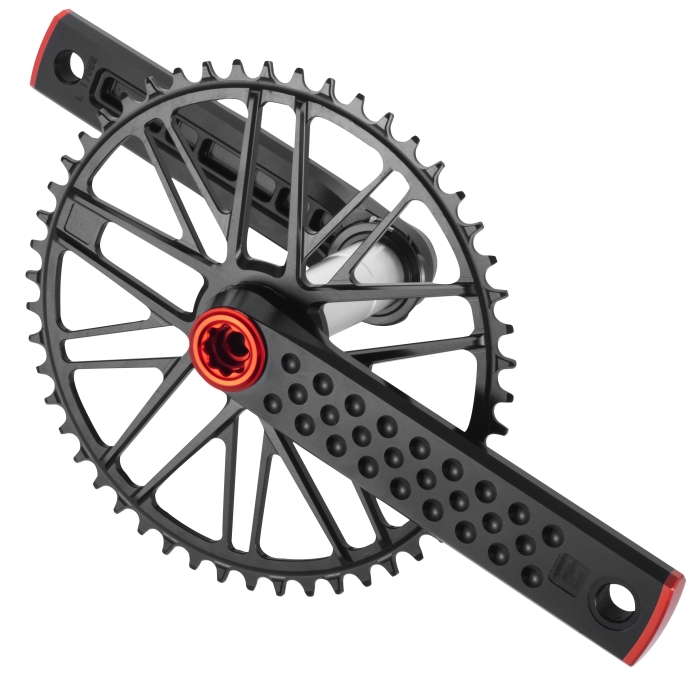
In actual riding, the importance of cranks is fully reflected. When the rider steps on the pedals and starts pedaling, the cranks begin to convert the power of the legs into the rotation of the sprocket, which in turn drives the chain to drive the wheel forward. A high-quality crank can make the pedaling feel smooth and smooth, and every force can be accurately transmitted to the sprocket without any lag or jamming. In the sprint stage, the cranks become the key to the rider's explosive power. Under high-intensity pedaling, the sturdy structure of the cranks ensures a stable output of power, helping riders rush to the finish line like an arrow from a string.
For professional riders, the performance of road bike cranks is directly related to the results of the competition. In fierce competitions, small performance differences may determine victory or defeat. Top riders are extremely strict in the selection and adjustment of cranks. They pursue the best power transmission and pedaling efficiency under various road conditions. For amateur cycling enthusiasts, a good crank can also bring a qualitative leap in cycling. It can make cycling easier and more enjoyable. Whether it is daily fitness riding or long-distance exploration on weekends, riders can fully enjoy the fun of riding.
The crank of a road bike, although not as eye-catching as the frame, is one of the core guarantees of bicycle performance. It silently carries every effort and passion of the rider, converts the pedaling force into the driving force, and leads us to ride freely on the road, chasing our own cycling dreams.
How to choose a road bike
Road bike drive: the surging power of riding