
MTB Chainring: The Starting Source of Cycling Power
2025-03-17

MTB Chainring: The Starting Source of Cycling Power
In the complex mechanical structure of MTB mountain bikes, the chainring holds a pivotal position and can be regarded as the starting source of cycling power transmission. It is like the conductor in a symphony, precisely controlling the rhythm of power output and determining whether cyclists can ride freely on various rugged terrains.
The design of MTB chainrings embodies profound craftsmanship and cutting-edge technology. The material selection is extremely strict, usually using lightweight and high-strength aluminum alloy or carbon fiber materials. Aluminum alloy chainrings, with their good toughness and fatigue resistance, effectively reduce the overall weight while ensuring durability, saving cyclists' physical strength during frequent pedaling. Carbon fiber chainrings go a step further. With their extreme lightness and excellent rigidity, they have become the favorite of professional riders who pursue ultimate performance. During high-speed riding or when facing high-intensity climbing, it can efficiently convert every bit of the cyclist's power into forward momentum with almost zero loss.
The tooth profile design of the chainring is even more exquisite. Each tooth tip has been carefully polished and optimized, and its shape, angle, and pitch have been precisely adjusted according to different riding needs. Wide and narrow teeth are arranged alternately to ensure that the chain can bite tightly. Even in the jolts and vibrations brought about by complex terrains, it can stably transmit power and effectively avoid chain jumping. This tight bite relationship not only enhances the safety of riding but also allows cyclists to feel a smooth and stable feedback during pedaling. It seems that the chainring and their legs have become one, and every exertion can receive an immediate response.
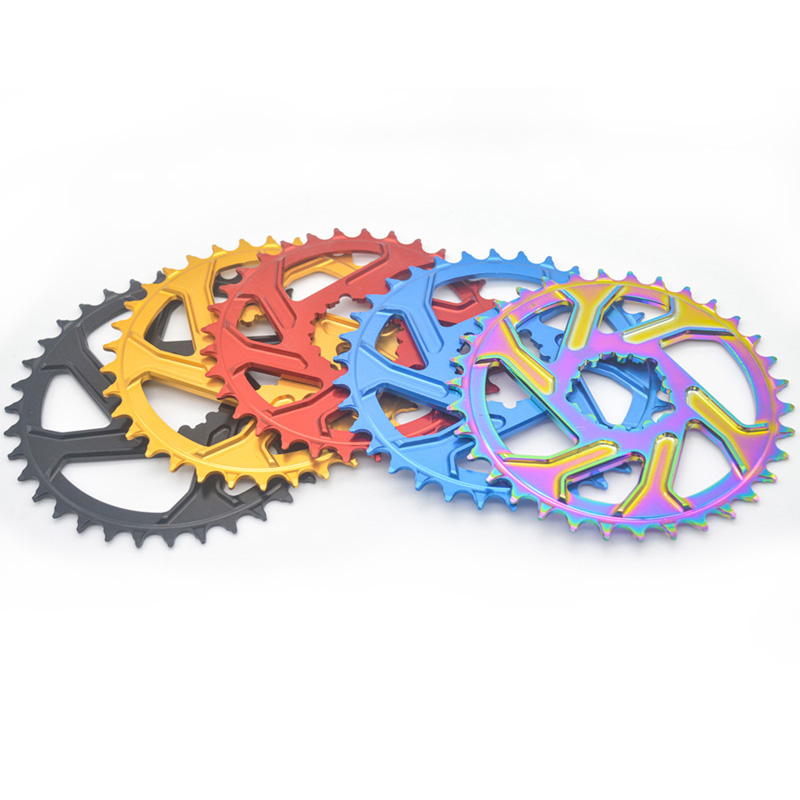
The diversity of MTB chainrings is also reflected in their rich specifications and the number of teeth available. Chainrings with different numbers of teeth are like keys, opening up different riding scenarios. Larger-toothed chainrings are like the engines of high-speed sports cars, showing their prowess on flat and open roads. When cyclists ride on flat roads or forest paths and switch to a large-toothed chainring, with the same number of pedal strokes, the bicycle can travel a longer distance. This not only greatly improves the riding speed, allowing cyclists to fully enjoy the thrill of speeding, but also effectively saves time and physical strength during long-distance rides, easily achieving high-speed cruising.
Conversely, when cyclists encounter steep slopes and challenge the gravitational test brought about by vertical drops, chainrings with fewer teeth become the magic weapon for victory. At this time, although the smaller gear diameter reduces the linear speed during pedaling, it significantly increases the torque. Just like using a lever to pry a huge stone, cyclists only need to exert relatively little force to convert it into powerful climbing power. Each pedal stroke becomes more powerful, and each rotation allows cyclists to steadily move towards the top of the slope, easily conquering those seemingly insurmountable steep slopes.
As one of the core components of the MTB drivetrain, the chainring works in concert with components such as the chain and cassette to jointly build an efficient and precise power transmission network. When shuttling through the mountains and forests, the chainring can, according to the rapidly changing road conditions, cooperate tacitly with other components to quickly respond to the cyclist's shifting needs. Whether it is an instant acceleration after a sharp turn or a renewed burst of power after crossing an obstacle, the chainring can promptly adjust the gear ratio to ensure smooth power connection without any sense of jerk. In urban commuting, chainrings with different numbers of teeth also play an important role. Facing congested streets and frequent stops and starts, cyclists can flexibly switch chainrings to find the most suitable pedaling rhythm, freely shuttling through the busy city and easily coping with various traffic conditions.
The MTB chainring is not just a mechanical component; it is also a bridge for power transmission between the cyclist and the bicycle and the key to unlocking a wonderful cycling journey. With its excellent design, outstanding performance, and rich adaptability, it brings an unparalleled riding experience to cyclists, helping every cycling enthusiast to continuously challenge themselves, explore the unknown, chase the free wind, and write their own cycling legends during mountain adventures and daily rides. Choosing a high-quality MTB chainring means choosing to inject a continuous stream of power into your cycling, making every ride an unforgettable adventure.
Fixed - Gear Bike Crank: The Core Power Driving Passion
MTB Drivetrain: The Core Hub of Cycling Power--Crankset